Sunday, February 26, 2012

Short Story. Lovely the Restavek.


Lovely
The following story is a glance into a day in the life of a child domestic slave in Haiti, locally referred to as a Restavek. There is an estimated 300 000 children forced to perform domestic chores in Haitian homes. These children are taken from poor families in the rural areas of Haiti and sold to poor families in the city. They are systematically abused, often beaten and abused both sexually and verbally.÷”ewq. Many run away to end up on the streets where a dangerous life of theft, hunger and homelessness await them. 
The child shifts in the space between the ground she lays on and the base of the bed above her. Her limp body stirs and she scrapes herself along the floor, and lifts herself out, into the small room. It is not yet light outside, but the dense darkness of the night has waned, and the ether is still, lingering like the pause between two breaths. Soon the sun will climb the sky, it will glister through the day, beating, bleaching, warming and spawning. It will beam through the cracks of huts made of corrugated iron and awaken. It will warm the rugged skin of pigs muzzling through waste-adorned desiccated riverbeds. It will animate legions of bacteria in the pools, the sewers, the mires in the streets, endangering the lives of those who have no other alternative but to drink and wash in the only source of water obtainable. It will bring lustre to tribulation, to the untold tragedies of survivors and of fighters, to an earth shaken by trauma, mourning and adversity. 
In ceremonious silence, Lovely unfetters the lock on the door and steps out into the semi-darkness. The rich stillness is fragmented by a crowing cock, and the distant whisper of a helicopter, obscured by the gloom of aurora. She hoists a fractured pail into her arms and scurries through the narrow passages winding through the modest shacks of the Port-au-Prince slum. Crossing vendors on her path, she lowers her gaze, as they push past her and carry on their droning calls. The firm soil under her bare feet turns to fractured rocks, and she expertly steps through them, without demur, making her way down the dirt track to a tent encampment below. A large four by four rocks past her, slowly navigating the terrain, jerking across the ruts, and leaving her in a pall of dust. The dust bonds to her skin, and clings to her eyelashes and hair, as if the ground that has thus swallowed so many souls will not renounce ownership over those left living. The tent camp is flickering with life. Children with bare bottoms run around in circles on the grit, laughing through the apparent starvation that their distended stomachs starkly reveal. The first rays of sunshine are illuminating the camp and warming the wet mud on the road skirting the tents. Lovely strides straight through the quagmire and disregards the putrid smell emanating from below her feet. 
There are already other children at the water pump. She waits. All these children dressed in rags, adorned with scars, with earnest miens spread across their faces, do not look at each other, but pump water into their buckets and hasten off into the morning light.
Lovely returns along the path with the pale of water resting on her head, steadying it with one hand. The smell of cooking oil floats in the warm gentle wind like a soft maternal breath. No one looks at the young girl as she strides past, her skinny legs mechanically following her fixed gaze on the track ahead. Her brow is dotted with sweat. The droplets run down her face, following the line of a scar stretching from her forehead to her cheek. She rests the bucket on the floor beside the entrance to the small shack. “Lave ti bebe a”, she hears a voice call from inside. She steps tentatively into the room. The darkness inside blinds her for an instant. Her eyes adjust and she sees a woman sitting on the edge of the bed, holding a naked baby. A teenage girl stands in one corner, pulling on a school uniform, and a young boy lays motionless on the bed. Lovely hunches her frame and, looking at the ground, lifts the baby from the woman’s arms and takes her outside to wash her, as she had been told to do.
The sun, aloft in the sky, is like a spotlight on the streets, slums and tent cities of Port-au-Prince. Groups of street children frantically run from car to car, armed with rags, washing windscreens, begging for a few gourdes. Two young boys, their skin and clothes grey from  dust and dirt, dart towards a white pick-up truck, whose sides are boldly branded with the letters ‘UN’, as it slowly approaches a set of traffic-lights. The boys start polishing the dark tinted windows with scraps of cloth and hold out their palms, rubbing their bellies. The lights change to green and the car moves away. A stream of traffic follows, and the boys stay motionless in the middle of the road, avoiding the scrapes from brightly coloured tap-tap vehicles, and quickly sidestepping swerving motorbikes.
Lovely watches them from across the road, clutching tightly onto the money in her hand, the notes greasily melting into her palm. She has been recipient to the attention of these boys before on her way to the market, and has suffered the penalty for returning home empty handed. As she steals glances at their feet in battered rubber sandals, their legs bruised and scared, their heads of hair a sooty grey and their faces worn and pained, she envies them. Some of them had been like her once. They had been compelled by fear, terrorised into an unrelenting motivation to keep working, keep alert, to always remain silent. Now they possessed nothing. They slept on the roadsides, amid the piles of trash, attempting to remain hidden from the gangs, police and wild dogs that drift through the streets at night. They drank water from the sewers, stole, begged or scoured the rubbish heaps for food. But unlike Lovely they had freedom. For most, their lives would be curtailed prematurely, and though filled with hardship, their waking moments would be free from the daily turmoil of systematic abuse.
The market is always busy. The sun is beating down on the sweating bodies surrounding Lovely as she rushes through the crowd, stepping on the flattened empty wrappers, packets, boxes the earth is carpeted with. Clothes hang from open stalls, school books are displayed neatly along the ground, aubergines adorn buckets next to bananas, dusty sweet potatoes and plantains. Music blares from a loudspeaker that sits surrounded by more speakers and shabby looking radios piled on a table. Women sit next to their small collection of live chickens and buckets full of medicinal pills. Lovely glances from seller to seller as she marches through the market, and suddenly the blasting colours of each stall turn to grey and black. Lovely stops and steps towards the charcoal sellers and it is as if she is stepping into a black and white photograph. She hands the grey woman two coins in exchange for a bag of coal.
Back at her master’s house, Lovely prepares food. She serves up the tchen tchen*, to the three kids and woman in her household and waits patiently sitting by the entrance to the house as they eat, hoping there will be enough leftovers for her.
The light over Port-au-Prince is turning to a subdued haze, as if the sun is jaded from a long day of burning so forcefully. The dust and the twilight mantle the city and the luscious green hills in the south, and the arid dry hills of the north. Music is still pumping through the bumpy, cracked streets, merging with the blaring of the motorbike horns, the shouts of the street vendors, the distant shrill chimes of water trucks. The water glistening in the bay glints stars of pink, orange, purple and gold. The narrow, winding streets of the slums nestled on the southern hill, Carrefour Feuilles**, will be the first to be plunged into night as the sun disappears behind the mount, and drops into the sea. Food carts will begin to emerge from in darkness. Trays of fried bannan and pate*** will borrow the light of a glowing bulb on a breadfruit-juice stall, a loud generator perched on the side of the stand powering a single blender. In the darkness, candle-light will flicker, shadows and silhouettes will move across the glowing embers from the vendors’ fires as they grill chicken and corn. Fires will spread through the piles of trash and glow through the billowing smoke. The dark streets will swallow up the people, the dogs, the houses. Whole neighbourhoods will sit unlit, waiting for a chance flick of a switch that will illuminate a section at a time, for an hour, maybe two. The dark streets of Petionville**** will be lined with candles like a church aisle, as women sit on the road with a single burning flame each, shining a warm glow on their wares. The headlights of cars and motorbikes will reveal, for an instant, what the dark depth conceals, people walking on the footpath, stationary moto-taxi drivers gathered on a street corner laughing, couples sitting on a wall beside a broken set of swings. The edges of tent camps will be lit by the flickering flames burning fires on the streets and the dim glow from cooking stoves heating cooking oil and barbecues. 
Then, little by little the candles will be blown out, and the fires will die. By nine o’clock the streets will be almost empty. The traffic jams will have dissipated. The taptaps***** will soon stop running. Doors and gates will be locked. Only some cars will be left on the dark roads, slowly edging through police checks as armed guards will stop passing vehicles, clutching tightly on to their rifles. Intimidation and fear will replace the flickering glow of the candles. The only people remaining in the streets will be the intrepid, the feared, the street-kids. 
Lovely will finally lay her body down to rest, in her place under the bed. She will go to sleep long after everyone else, kept up, still working, into the night. As she lies on her sheet of cardboard, she will close her eyes and try to forget. 
She wills to forget the disregard in the eyes of her peers, the hand that fed her, as if she is a wretched dog, the strike of the leather belt as it swept and broke her skin. She banishes the fear and grief from her tired thoughts. Pushes away the memory of the time spent with her neighbour that day, the man who strips her from what little feeling of beauty she feels she holds, like a rough hand tearing away the fragile petals of a wilting wildflower. She quells the faint memory of her mother, her home by the sea, her brothers and sisters and how they would play in the dusty street, then let the waves on the pebbled beach swirl around their ankles. She is haunted by the memory of the sound of her own laughter, of her mother’s voice, of her own voice, as they sounded so golden, spoken in childhood and love, and now only in solitary dreams.
Years of being a Restavek have taught Lovely never to cry, never to voice her needs, her pain. Her hunger withers and her dreams of escape wilt in the darkness of every passing night. The sun rises each day and with it, she listlessly follows the hopeless path to the water pump, to the market.. Her sole resolve, as she marches through the hostile streets of the crumbling city, her young eyes falling on disease, hunger, injury, death... to not let her life get any worse.
  • Dish of maize and beans, locally known as tchen tchen, a Creole name which comes from the french ‘Tiens, tiens’, which means ‘Take, take’.. In the past, this was ordered at the slaves by the French when giving them their daily rations, the dish thus adopted the name.
** Carrefour Feuilles is a very large slum in Port-au-Prince, located on the side of the mount of Kenscoff.
*** Bannan is plantain and Pate is a Haitian pastry delicacy often filled with meat or fish.
**** Suburb of Port-au-Prince
***** The only form of ‘bus’ in Haiti. Basically a pick-up truck with a roof mounted on the back, and painted a multitude of bright colours, often stating thanks to God in Creole, or something like ‘Jusqu’ici l’Eternel nous a Secouru’... ‘Thus far, the Eternal has kept us alive’..

Thursday, December 8, 2011

Candle-lit Streets..

I’m sitting in the Port-au-Prince airport, waiting to board a flight to Miami, with dust in my hair from the motorbike ride here. We darted through the chaos of the traffic, the tent city near the airport, the roads covered in rubble and pools of unidentifiable brown water, with my big rucksack on my back, trying to keep my balance as we swerved around tap-taps and erratic drivers. I got my last view at the Port-au-Prince horizon, with its spectacular hills covered in people’s humble dwellings, the sun setting behind the southern mount, projecting that unique beautiful dusty light, warming the tones of the colorful streets after another day of harsh, bright sunlight. As we drove, I imagined what the streets would look like in a few hours, still buzzing with people, lit only by the vendors’ candle light lining the roads, as they sit with their wares, fruit, veg, gum, shoes, pills, rice, books, clothes, charcoal.. I imagined the strong, thick darkness that exists here, and the silhouettes of people against car headlights, or mounds of burning trash, creating a smokey hue and adding an element of disaster, of urgency to what Haitians will view as just another evening, just another day in this difficult, hostile place. I imagined that a little later, after I’ve gone, the streets will be deserted, around 9 o’clock, as people will be tucked deep inside the winding, tight streets of the cluttered housing, with their doors well locked, going outside only if absolutely necessary, fearing and knowing that at night, the bandits and the wild dogs, rule the streets.

The waiting room is small and full of people, with different airlines operating from one small gate. The airport was completely destroyed nearly 2 years ago in the earthquake and the system they’ve had here is makeshift, with a wooden wall skirting the cluttered seating, behind which is loud banging, as they are rebuilding their airport, rebuilding the country, slowly, rebuilding their lives. I am sitting here knowing that the next few hours will be my last this year as a white minority among the people around me. My constant attempted creole inner-dialogue will fade, and the comfort of the warm air will leave me, as I will pile on layers of warm clothing to soften the blow, the shock of being back in Europe in the mid winter.
I’ll be safe again. Safe on the roads, safe in my home (well, my father’s home), safe from people trying to rip me off, safe from always fearing what I eat will make me sick, safe from the mosquitos, the most persistently annoying creatures in the world, safe from the treacherous pavements in the dark and the frequent giant open sewers which are so easy to step in and fall ten feet down, safe from the discomfort of having to refuse or ignore beggars, to turn away from obviously needy people reaching out their hands for me to help them.. I won’t feel like the stupid looking rediculous blanc everywhere I go, doing things backwards, a walking joke. I’ll wear make-up again and blow-dry my hair.
But this promise of organized society, of safety, doesn’t bring me comfort. It just makes me feel sad to leave Haiti, a place where doing the simplest thing is a huge challenge.. But it’s a challenge that I love. And I can’t wait to come back, not just for the thrill of living in such an exciting, shocking environment, but also, well mostly because, when I am here, what little effect I am having around me, I know that I am doing everything I can to help some of the poorest people in the world. I haven’t found a fluid channel through which to help the children of Haiti trapped in slavery yet, and as frustrating as that is, I know I am doing everything I possibly can to make a positive impact in Haiti, giving all that I have within me to do this, to find a way to help, and that is both frustrating and deeply satisfying. The work that needs to be done here is so huge it makes you want to give up, but the work that needs to be done here is so huge I can not give up.
So it is with a heavy heart that I leave this island. Heavy with the burden of need here, and the love I have for the place. Heavy enough that I know I will be back here in the new year, I still have a lot to give before I give up.

A pi ta Ayiti Cheri x

My dear, dear friends..

To all of you who have been supporting me and following my progress, I want to let you know that I am flying to Amsterdam this evening because I have a little medical emergency I need to attend to, and do not want to risk treatment here in Haiti because of danger of infection etc..
I am going to stay there until January, and then return to Haiti on the 12th.
It is an annoying and expensive inconvenience, but, as many people have reminded me, I must put my health before all else.

Thank you all so much for your support and I'll keep you updated...

Xxx

TapTap!

Most Haitian people get around by TapTap.. These are basically pick-up trucks with a roof on the back, and decorated in beautiful bright colours and always have phrases painted all over them like "Jesus revient" (Jesus is coming) or "L'enfer est réel" (hell is real) or my personal favourite, "Jusqu'ici l'eternel nous a secouru" (this one is too poetic to translate, but roughly means: to this point, eternity has saved us)

It costs between 5 and 10 gourdes for a journey which is about 10-20 euro cents. People pile in and hang off the back of them. Once I got one and had to sit on some man's lap as he carefuly opened my bag without me noticing.. unluckily stumbling upon my stash of tampons and hair clips. Sometimes, like today, you have to kind of run up behind one and jump on while it's still moving, it's pretty fun. Then once on, people always point out the fact that I'm white.. as if I hadn't noticed!
The one I was on today broke down, as they often do, and as I sat there peering out of the back - with everyone around peering back at me - I saw a dude in a big straw hat fill up a bottle from a running sewer and drinking it. No kidding. Bonjour Cholera!
Anyway, then I got out and walked the rest of the way through the hot streets of Delmas, the area I live in, with people shouting "Blanc, blanc!" at me, and women holding their babies up to me, with their hands out asking for money.


The TapTap experience is cheap and fun.. but most foreigners are discouraged from riding them.. safer than a motorbike though!

Monday, November 28, 2011

Why Haiti..

It's occured to me that many of you may not know why I really came to Haiti, why I have wanted to come here for so long. It has come to my attention, through the unbelievable support I've been getting that many of you reading my blog are probably not aware of my passion, the driving force that led me here to this difficult and fascinating place. So let me explain if you care to know.

The word is Restavek.  What does it mean? Well, it is a Creole noun that means 'stays with'. What does it really mean? I will tell you, but before I do I want you to promise to read my words with an open heart, a heart that truly feels the pain of this thing, it will hurt, but that is the manner in which I write about this and hope that it can be read with the same reality and human connection.

Each Restavek case is different, so I will tell you about the most common practices.
It all starts in rural Haiti. Poor families, with little to live off, many mouths to feed, and no money coming into to the household. Pretty much all schools in Haiti are private and fee paying, so kids from poor families will often not be able to attend - even though education here is very highly valued, and what little money comes in is often put towards school and uniforms etc over food.
Then one day, a lady comes to the house and offers about 2000gourds (approx 40euro) to take one of the children away and place them in a family in the city where they will be fed every day and sent to school in return for some household work. It must be noted here that there are no amenities in Haiti. People do not have washing machines, dishwashers, vacuum cleaners. No running water for washing, cleaning, cooking, drinking, flushing toilets, no electricity for light, for cooking, watching tv, charging their phones. No refuse collection, no postman, no social welfare. All the things that these machines and facilities do, need to be done manually, and it's pretty much a full time job.
So the lady (trafficker) takes this kid to Port-au-Prince, to a slum, and sells him/her to a poor (a little less poor than the child's family) for about 3000 to 4000gds (60 - 80 euro). This child is now a Restavek. A child staying with a family that is not his/her own. Restaveks can be boys or girls (more girls, but not by much) and usually aged 5-14 years old - they can be younger, they can be older.
When they arrive in the new environment, they are forced to work day and night. They perform all the household tasks, walk to and from the water pump many times a day, in their bare feet, wearing filthy rags, as they wash their new "family's" clothes. Haitians dress very proudly, always in pristine clothes. 80% of these restaveks are physically abused daily, they often display many scars. And approx 80% of the girl restaveks, and some of the boys too, are repeatedly sexually abused, often rented out to the neighbours too.
They are not fed any food other than the scraps, when there are some, of the food they have prepared for the family. They are not sent to school as promised either, sometimes allowed to go occasionally when all the work is completed, but this is pointless as they will always stay too far behind to make any progress.
Haitian kitchen
They have no place to sleep. They will crawl under the bed, or kitchen table, or find a little corner to put their head down. They have to stay up long after everyone is asleep and get up long before anyone wakes.
This is Slavery. There are about 300 000 restaveks in Haiti.
Many run away and they become one of the hundreds of thousands of street kids. They grow up, join gangs, commit crimes and often end up getting killed.

I spoke to a guy from The International Organisation on Migration (IOM) the other day who told me about a recent case where a 14 year old restavek got pregnant after being raped, and the 'mother' in the household gave her an abortive tea which killed her as it comprised mainly of rat-killer. There is no system of prosecution for cases like these. No system of protection for these children.

Haiti has so many problems. It had a multitude of unsurmountable problems before the earthquake, and now, millions are still displaced and homeless, thousands are dying of cholera.. The list of priorities to help Haiti is endless.. and restaveks are nowhere near the top.

But they are at the top for me. They are the reason I am here, and the reason I chose to dedicate my life to contributing to the development of this country. For me, this isn't a short trip, to do my time of volunteering and to return to my life.. this is my life, it is a path I chose 4 years ago when I first learnt that these kids existed, when I decided i refuse to live in a world where this exists, and therefore will do everything in my power to stop it. Bit unrealistic, I know, but one can dream?

Saturday, November 12, 2011

Timoun yo

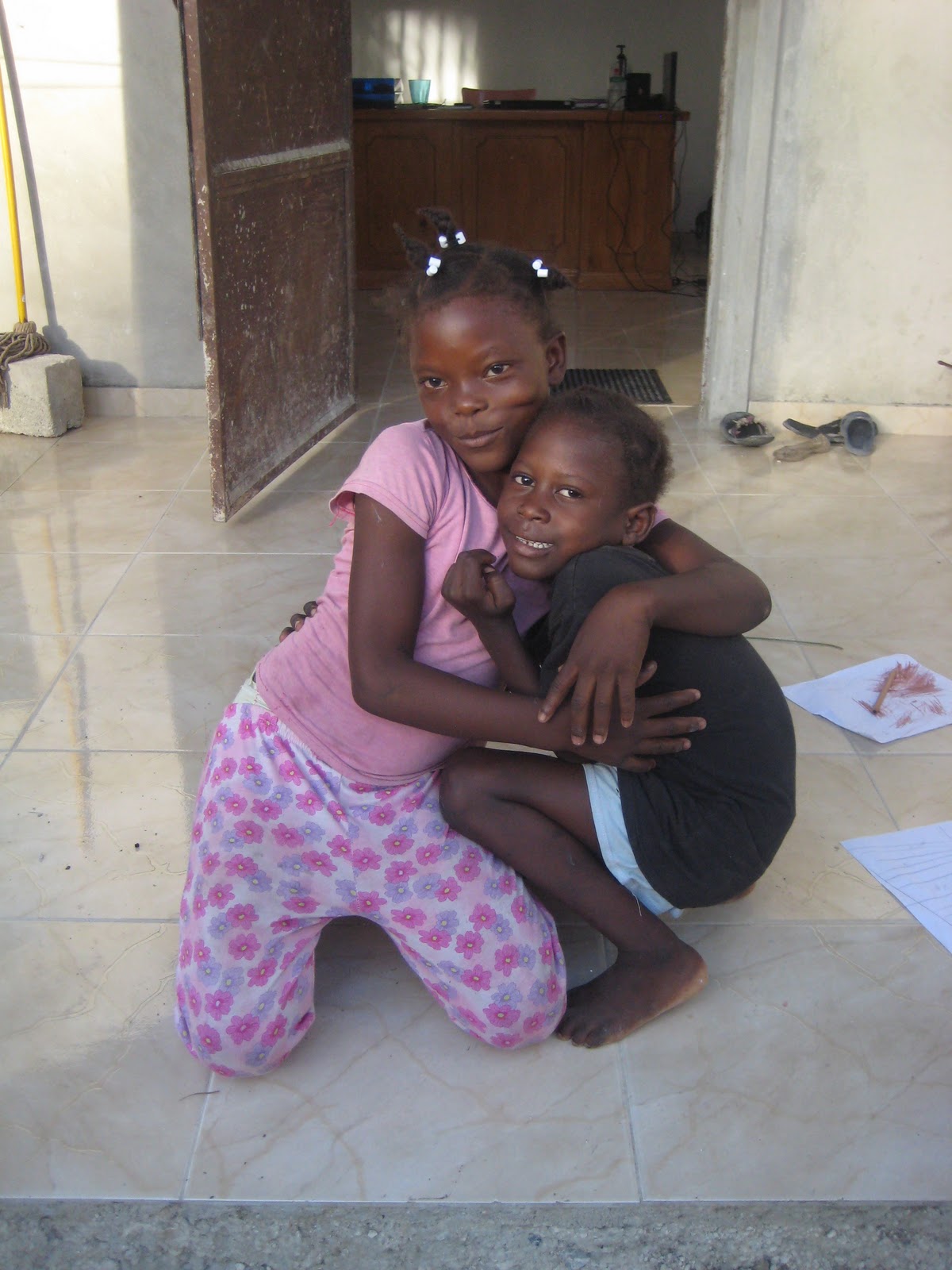
Vaina had just pushed another kid out of the way before plastering a big smile on her face for the picture..


Ismaelle and Methaida, so sweet / so cheeky!

Vaina showing off her art work.. and herself.

Timoun yo

As much as I try to slip by unnoticed, this gang follow me all around the neighbourhood..

Her mum is called Lovely :)

They look cute... bu they're a HANDFUL!! Ha ha

It started to get out of hand and they got angry...

Some were a little confused...

Others were born to be in front of the lens, he he!

Tuesday, November 8, 2011

Dog eat dog..

Yesterday I was sitting in the car with Moise driving and Frantz in the back (KCH students) and we ran over a dog :( big THUMP.. apparently he walked away.. probably fatally injured. That really made me sad. There are lots of street dogs here, just scavenging the garbage heaps 24/7.. most are really skinny, many have ailments.. Some lie dying on the side of the road.. If there wasnt so much other tragedy here, I would be so tempted to help them!!

Monday, November 7, 2011

The Donate Button....

Hi everyone..
I hate asking anyone for money.. but I am currently in a really difficult situation.
I have arrived in Haiti to a house which is inadequate to live it.. even by local standards. It is unfinished, unsafe, spooky, filled to the brim with mosquitos (the mosquitos here carry diseases like malaria and dengue), the water here has countless diseases, like cholera and I have to be very careful what I ingest.. I already got violently ill whilst in that house, i dont know what from, but it is clear to me I can't go back, until at least, it is finished with mosquito nets on the windows (to also keep the tarantulas out - which can also make me very sick.. I have also heard there are scorpions here) and a kitchen so that I can occasionaly heat some water or some soup or something...
Electricity will always be a problem there, and the internet will never be reliable. (I'm not sure I can live without those, alone, for a year)

This is a pig.. just wanted to break up the text.
Basically, I am looking for other accomodation. I dont expect luxury, I can live very basically, just not alone in those conditions. The organisation I am working for cannot afford to help me with my living costs outside of the office, and rent here is surprisingly very expensive.. Way more than I was paying in Hull! I am going to have to spend all of the stipend given to me by the organisation which is enough to cover very basic food, on providing myself with a basic home.. and even that will only cover half of my rent, without taking into account transport (I have to go everywhere by motorbike taxi which is expensive, but i have no choice) and food..
The fact is, i simply do not have enough money to stay. BUT I dont want to go home!! I desperately want to be here and do what I came to do.. Haiti has been my obsession for 4 years now, and everything I have done in that time has been leading up to this. I have given up everything to be here, my job, my flat, all my possessions (bar a few trinkets in storage - thanks Fi :)), my loved ones, family and friends..
I am risking a lot being here too.. my health, my safety, but this is my passion. To give something back to these people who are suffering so so much, who have been forgotten by the world. I don't want to go 'home'.
So please, I hate so much to ask... but I am desperate.. If you can spare a few quid, I would appreciate it so so much, and I can assure you, it is not so I can live in luxury and have loads of fun! Life here is incredibly hard, and in order to do my job, I need a minimum of safety, comfort and sanity..

Thank you my dear friends..

If you see value in my work here, and feel you want to contribute, please click the donate button to donate to my paypal account.. Thanks xxx

Friday, November 4, 2011

Day of the Dead


The 2nd of November was the day of the dead here in Haiti. Mostly that means a big voodoo festival, but seeing as I am new here, I haven't yet witnessed any explicit voodoo.. I know, however, despite my scepticism, that it is not something to mess around with. I'm sure in time I will see some of the otherwordly things they do.. and I'll keep you informed.

Every thursday, the hospital where I am currently staying take their unclaimed dead to a mass burial site just outside Port au Prince. On the Day of the Dead, a mass is held there, which i went along to, curious to see this site and to connect a little more with the reality here.. the reality of death all around.
Cars were leaving from the hospital and I was climbing into the back of a pick-up truck when I was ordered inside the car.. "This isnt tourism," Sister Judy said, "we're driving through areas where there's been kidnappings of blancs[whites]".. This woman is American, and a little bossy to say the least.
We drove out of Port au Prince, to the north, until the houses were fewer and fewer and all that was left was a barren hill with spread out shack and tents.. Thousands of people had been relocated there from the inner city tent-cities, but they had not been provided with any facilities like water, sanitation, electricity, so most ended up going back.. Just another example of misdirected goodwill.

We then got to a road really close to the sea that was glistening and blue. It looked so inviting and also spooky.. as we drove, Sister Judy explained that before this burial site was adopted by the organisation, the state dumped the thousands of dead bodies in the sea. Human bones drifted back onto shore and clothing could be found along the coast. We then drove up a tiny dirt track into thick thick smoke. Piles of garbage were burning on the hills around us. 
We arrived in this eery landscape, on the day of the dead and were met by a dozen, even eerier, nuns, who had traveled from their convent to the mass.
There were a few crosses stuck in the ground, but they were not marking individual graves.. each grave had hundreds of people in.
This is a site where hundreds of thousands of people were laid to rest (dumped) after the earthquake, nameless, forgotten, their families still not knowing their whereabouts.

The nuns sang in the mass, songs in creole, english, french.. and the rituals were performed in their usual fashion.. weird and surreal to me. The day was in honour of the dead, and the point of the mass was to pray for the sould of the people buried here and to ask them to pray for us down here. A faint rainbow appeared in the sky (it was kinda raining, not really that weird) and the small crowd all jeered and echoed 'oh my goodness', 'a gift from god'... Yeh.. a little annoying. Anyway.. the site itself was not annoying.. It was an area of three rolling hills and the third in the distance was where the burying began.. thousands of people dead from the Duvalier regime, then hundreds of thousands from the earthquake, then cholera, and all the other ailments inflicting these poor people, up to the spot where we stood. And to our left, another hill, which will soon be full as well.

Burials here in Haiti are BIIIIG business.. Praying for the souls of the dead, and a big send-off into the afterlife is one of the few things that even the poorest of Haitians will spend THOUSANDS of dollars on!! It's so sad. They cannot afford to feed their kids or send them to school, yet they will do anything they can to provide an expensive funeral for a loved one.
The people buried at this site by the hospital priest, are those who were so poor, they were abandoned in death.
Then the band started playing some happy music (there's always a band, and a party at the end) and the ceremony was over."When the Saints"

I left feeling very moved. Happy to have seen the site.. reflecting, and reminded of all that has happened here.. and continues to happen. And amazed at the beauty of the landscape as we drove away from the hills back towards the sea over which the sun was setting, the city sprawling out below us..
Will my heart ever learn to cope with the tragedy here..


Wednesday, November 2, 2011

Better health, happier thoughts!

Yesterday I went to a part of Port-au-Prince called Delmas to find a guy up on a hill to give me a Thai massage. My ill health and distress gave me so much tension that I got an awful, immovable headache, which I could see past. I knew I needed someone to pummel my neck and to relax for a moment. Today I feel like a new person! Headache is gone! I am in such a good mood, and able to think through my issues here a lot more clearly! The experience of finding his house was amazing too. I was on the back of a motorbike, with my preferred driver Jean-Claude, and we drove round and round for ages. We ended uo in a really nice, rich area, where one house was completely flattened by the earthquake.. I tried to imagine it happening and hoped the house had been empty when it collapsed. It was a really nice house, kinda 1970s James Bond lair style, in a nice area... The earthquake certainly did not discriminate.
We continued driving up a dirt, very very steep track and quickly ended up in an area of slum-like cement houses, where a little bunch of outhouses proudly displayed the stickers of the Irish NGO GOAL. We went up and up and up, willing the motorbike forward, stopping to ask for directions every few minutes, until we got to the top and found the house. Daniel, the masseus, a really nice, gentle guy who has lived in Switzerland for the last 20 years was waiting and i spent one of my favourite hours here in Haiti, clearing my head of all the millions of thoughts, relaxing my muscles and healing.. It was great :)

I have been given permission to stay at the hospital in one of the volunteer houses for 2 weeks, during which time I will search for a room to rent. My only problem is financial. One thing is clear to me right now, i cannot, for my health and sanity stay in the office. It made me sick and I feel so uneasy there.  But I so so so so so want to stay in Haiti!!!! I need to find a way.

I had a wonderful meeting this morning with one of our students, who is studying development studies. He has all these amazing ideas to help Haiti, to develop the country starting with the environment. I'm looking forward to seeing him work on those ideas and am so pleased to be able to help him to help his country.

Here are some pictures of the cathedral:


Ill health and sad thoughts...

Sorry for leaving the last post on such a bad note.. i've received many worried messages, thank you for those! But please, do not worry.. (it only makes me feel guilty for choosing to do this!) And I'm fine, or at least I will be. I have been wanting to do this for 4 years, I knew the risks, and was aware how difficult it would be..
For there to be life there has to be birth! And birth is a pretty nasty thing to go through.. I am being born into Haiti, and I'm feeling vulnerable and scared like a newborn.. But I will be ok, Mama Haiti will look after me, and I will love her. (It is possible this analogy sprang into my mind because I am currently staying beside the maternity wing of the hospital, and can frequently hear the screams of labour...)
From what I observe, life in Haiti is so entwined with Birth and Death.. Well, my experience of it is.. How many babies have been born next door since I arrived? Judging by the screaming coming from those women in labour it's quite a few.. Where are these newborns gonna end up? What kind of life will they have? How many will survive their first 5 years of life? The statistics don't look good..

I went back to the office last week for one night, to sleep in my bedroom. My mosquito net fell on top of me in the night. There was no water, and I got the beginning of a migraine that is still ongoing 5 days later. So I came back to stay in the hospital with a friend of Astrid's. The office, with my bedroom attached, is unfinished and I'm not comfortable there. (understatement) The mosquitos there are in their thousands, im not joking, and this is a zone of high risk of malaria.. it only takes one bite! There is no electricity most of the time, so no internet either.. There is no furniture, no kitchen, no cooker, nowhere to boil water for a little green tea, no fridge.. just a desk and a chair and my bed.. and total darkness at night.. strange noises around coming into the house through the windows with no glass..
The real problem is the isolation and loneliness. I am detached from everywhere else by a difficult and expensive motorbike ride..
Anyway, the point is, if I want to stay in Haiti, I cannot live there. I am looking for a room to rent.

A couple of days ago, one of the volunteers here took me on a tour of the hospital. There is an orphanage (or boarding house - some of the kids' parents are alive but dont have the means to care for them) a new wing for the treatment of cholera - that was a hard one, little skinny kids on drips with their mothers at their bedside..
Then there is A&E, maternity, and the pediatric hospital.. I visited kids in the cancer ward who all called me "Princess Fiona", and then the room where the abandoned babies are.. ones who will have just been left on the steps of the hospital, many of them handicapped in some way. My experiences in Thailand prepared me for stepping into a space where babies with hydrocephalus (water on the brain, where their heads are swollen to 2 or 3 times their normal size) are waiting to die, and others with severe deformities.. There were two babies in there with cholera, also waiting to die.. One was 3 months, the other was 4 months, but between them, they wouldnt have weighed as much as a healthy newborn. They were soooo tiny, arms like matchsticks.
I took a little 13month old, Lubin, out for a little walk.. as he waddled along, leaning on his walker, i thought about my parents, my brother, my cousins, my grandparents.. all those people that love me, that support me, encourage me, unconditionally! And how this little adorable creature has nobody in the world to love him. No one is going to hold him close when he is crying and say any real words of comfort. I thought about how that is going to become his reality as he grows older, stronger and totally independent - because he will have to in order to survive.


Wednesday, October 26, 2011

Some pics

The Port au Prince hills are covered in these houses..

Some of my neighbours

Happy I am not dying

On my drip - I love Haiti

My holiday in hospital

To be in an air-conditioned room, with constant electricity and excellent internet connection and running water.. that is worth 13 hours of non-stop puking!!
On sunday afternoon I started to feel really ill, and by sundown I was throwing up pretty violently. It continued all night long.. Lying in my bed, every movement I made made me throw up, accompanied by diarrhea of course, and much much trauma!! I was hating every second of it, freaking out with every thought.. I thought the thunder was an earthquake, I thought the dog outside was a mystical gigantic creature roaming through the darkness, I was convinced someone had put a voodoo curse on me..
I decided I was definitely going home. I don't wanna die here, i thought.
Thank god Astrid was still here, she drove me to hospital first thing in the morning.. not before more puking beside the car before getting in (sorry for being so graphic)
They put me on IV fluids immediately and i stopped throwing up eventually.
I've taken a few days out to recover, staying with Astrid's friend who lives in the hospital in a volunteer house. I'm trying to regain my strength, to eat more (I must've lost at least 10 kilos overnight) and most importantly to find my positivity in this project again...
Working on it....

I knew there would be moments like this, and im not moaning.. Things are just UNBELIEVABLY difficult here. And Im so lucky, i can leave! But to be stuck here, where EVERYTHING is a huge effort.. food, water, sanitation, transport, health.. Life is so so hard here, and it's a huge adjustment for me.. and all the time, my heart is heavy, as i look around at how much people need to struggle, needlessly.

Astrid is now gone and I'm on my own from hereon-in. It's pretty darn scary.


Monday, October 24, 2011

My first week in Haiti

Me in front of my new house


Haiti.
I can’t believe I’m finally here. After years of trying to imagine what it’s like, of learning, reading, and crying about all the suffering and sadness that has happened here, I’m finally seeing this place with my own eyes.
With Haiti’s history instilled in my mind, I arrived on the plane from Miami. I looked out of the window, scanning the landscape I had learnt to be so bare and so sad, but what I saw was amazing tropical breath-taking beauty! Green mountains, winding rivers flowing into the sea, untouched stretches of sandy beaches, and that blue, blue caribbean sea.

I stepped off the plane and took in my first breath of hot, dusty Haitian air. I was the only white person on the plane traveling alone, among the American evangelists wearing their matching bright yellow T-shirts, apparently on their church’s yearly weekend trip to Haiti. Lucky for them, however short your trip, or short-term your impact, you get a lot of cudos for having the word ‘jesus’ on your t-shirt.
That is one of the big things you notice here. Jesus is everywhere. I see that name at least fifty times a day. I find it amazing. There has been so much pain here, so much suffering, shock and misery and they continue to give thanks to their god. Thanks for what? The lack of basic facilities needed for survival? The violent hurricanes that have ravaged their lives? The deforestation of their beautiful landscape? The earthquake which has affected every single person here in Haiti, killed a loved one, robbed so many of their very last humble possession... Oh I could go on and on, and I will. After a flight of about an hour and a half from Miami, it is impossible to get one’s head around the contrast, and it is difficult to suppress the anger towards how richer countries, like America, have made positive contributions to keep Haiti down.. Economically, politically and consequentially socially...
Haiti’s history is one of abuse by richer powers, from before its very beginnings, its current population being descendants of African slaves, abducted from their lives, robbed of their last thread of humility and humanity. It was the slaves’ brave and violent fight to regain these that rid Haiti of this system of abuse, and invited in a politic of independence, wherein Haiti began its lonely struggle to survive, a brave island, on its own in a sea of opportunism, exploitation and revenge.

The Haitian history is a fascinating one, pivotal and crucial in the history of the world, and one which I will not lay out in chronological detail, but to which I will refer to often. It tells the story of bravery, leadership, strength and courage, overcoming injustice against all odds. It tells the story of a people unwilling to accept their situation of extreme exploitation,  who, with hatred and rightful anger, will risk all they have to gain their freedom, whatever the cost. Whatever the cost. Their success has indeed come at a great cost, which Haitians today are paying with their lives, their health, their own humanity.


I spent the first couple of days in Port-au-Prince sitting in the back of a pick-up, watching the my new world go by, letting the heat of the tropical sun touch my skin, and welcome me to my new home. The weather is perfect! Very hot!
My first thought and surprise about Haiti is how beautifully green it is in the suburbs of Port-au-Prince. There are some really beautiful big trees around, with brightly colored flowers decorating the high branches and big fat green water retaining leaves casting relieving shade on the streets below. Lovely!
The roads are crazy. I have never seen roads like these anywhere, they are covered in pot-holes, (massive pot-holes!) and driving seems to be an obstacle course just to dodge them and if possible avoid crashing into anyone else. Makes for a bumpy ride.
As we drove around between the districts of Tabarre, Pernier, where I am based, and Pétion-Ville, myself and Aron, one of KCH’s DC based interns, sat in the back of the truck and discussed the landscape unfolding before us. Haiti is very mountainous, and Port-au-Prince is between mountains, which means there are some great views to behold. We discussed how we expected to see a lot more rubble and damaged buildings but were surprised there wasn’t so much evidence of the earthquake of January 12th of last year. Hmmm..

So on Saturday I arrived in my new home, the KCH office in Pernier, Port-au-Prince, which I will be sharing with Frantz, a young Haitian man, an orphan on the KCH program. I had been pre-warned that the house was basic, so I prepared myself, with an open mind, and the knowledge that I am so so lucky to be used to living in the conditions I know, and that this here, Haiti as it is, is reality for many many people, and the house I live in which has no furniture or kitchen yet and mostly no electricity is luxury here where hundreds of thousands of people are living in tents and make-shift tents held together by tarpaulin and whatever else they could find.
So to describe my house, I do not want to appear like I’m complaining, I just want to give an accurate account. So its a big room with a nice tiled floor. There are windows high up in the cement walls but they have no glass in, just metal bars, so mosquitos and other miscellaneous creatures are free to come I and hang out. I have a bedroom with a ceiling fan which works when the electricity comes on - which is always an exciting time :)
Apart from a single bed and a mosquito net, my room is bare.
There is water which Frantz has to get in a big barrel (from somewhere, I’m not quite sure) and fill bucket by bucket into a tank on the roof. So I only flush when necessary ;)
There is a banana tree next to my house and when they are nice and ripe, my plan was to stick my hand out of the window and pick one for my breakfast...... Until......
Last night, I was sitting on my porch, minding my business, talking to Astrid, my boss and Aron the intern when in the candlelight I saw a distinguishable shape on the wall. I shined my torch on it and said in a calm voice, “THAT is the biggest fucking spider I have EVER seen”. It was a tarantula. Yes. A mother of a tarantula, bigger than any I had even seen in ‘captivity’. I would guess it measured roughly 30 centimeters in diameter. Frantz tried to kill it with a plank but it scurried away into a hole in the wall.. Back to its banana tree.. It was the biggest he’d seen, but apparently they sometimes come in the house.. I have no windows.

KCH is an organization, run by Astrid Fitzgerald in Washington DC, which helps young Haitian adults, who have mostly grown up in an orphanage just outside Port-au-Prince, to access education, whether it be primary, high school, vocational training, or university. There are 40 people on the program, aged 18-25, half of which are involved in micro-business training, to facilitate small, income generating businesses among them. The other half are in schools and universities. These young people come to KCH desperate for an education and qualifications. Unfortunately KCH is only small and can only support a small number for now, and the biggest challenge is fundraising to support these kids. (I say ‘kids’ half of them are the same age as me.)
My job as the KCH program coordinator means I am the KCH representative and presence in Haiti. The students come to me first and I liaise with Astrid in DC.
I guess I’ll have more to say on that as my role develops and once I fully know what Im doing.

On Monday I asked Astrid if I could see ‘downtown’. I wanted to see the flattened palace. On the drive down from Pétion-Ville, I started to see real tent cities, destroyed buildings, houses, churches, shops, schools... We drove down an incredible road where I saw my first view of the massive hillside covered in slum-like cement houses. At night the hillside is mostly dark, because they don’t have electricity most of the time, but in the day, the piled-up shacks make a beautiful tapestry of sand-colored shapes, with flashes of colourful tarps, buckets and washing drying against the walls and the heaps of rocks and rubble. Dispersed between the communities are large groups of tents, hanging on the mountain edge, taking up any expanse available. I caught glimpses of this breathtaking view between the leafy trees lining the road and climbing the hillside of Pétion-ville.
Pétion-ville, a suburb town of great contrast, we had had lunch in a beautiful restaurant called ‘Quartier Latin’, in a large old colonial house with a leafy garden and tablecloths. Directly across the road from Quartier Latin, is what used to be a pretty green square but is now a tent slum. The boundaries of the tree covered park are marked with hostile-looking backs of make-shift tents, made from gathered pieces of tarpaulin, with the occasional source draped across someone’s home.. USAID, CONCERN.. The streets of this city are branded with these big names. Kids walk with light blue UNICEF school bags, tent cities are lined with latrines and water tanks donated by GOAL, most cars (all four by fours) display the associated organisation on the side.. Medicines Sans Frontiers, Red Cross, and countless smaller NGOs.. And of course, everywhere you go, UN trucks drive past, with UN officers dressed in camouflage, carrying huge shotguns, always with their distinguishable light blue helmets.

We drove further into the centre of Port-au-Prince, with three of our students in the back as it is not recommended to go there alone. There was more and more rubble around, more building ripped in half. We turned a corner and I saw the enormous cathedral, big and ornate enough to rival any European cathedral, with only some of the walls left standing. I got out of the car with one of the students, and immediately was surrounded by children holding out their hands. A mother holding her baby who was very obviously suffering from malnutrition stood and looked at us. I walked to face the cathedral, and the front wall towered above me, the big front doors, now only an open archway allowed me to see straight through into the vast open space.. The few pillars left, the beautiful ornate flooring. The large rose window still clutching on to a few shards of colored glass. The only thing left intact is a small white crucifix with Jesus’ suffering nailed to it.  I asked my friend Moise if there were many people inside when the building collapsed. He said yes.